At an accountancy we worked with, someone who likes tinkering with new tools spent an afternoon building a set of skills that automated most of the month-end close. For a medium-complexity client it did eighty percent of the work. Super impressive piece of building!
Then it just sat there. It never got more reliable, it never spread to the rest of the team, and the close carried on being done the old way by everyone else. The person who built it moved on to other things.
Just building an initial version of an automation is no longer the hard part. What happens with that initial version depends a lot on who else is on the team - but, it's not about job titles.
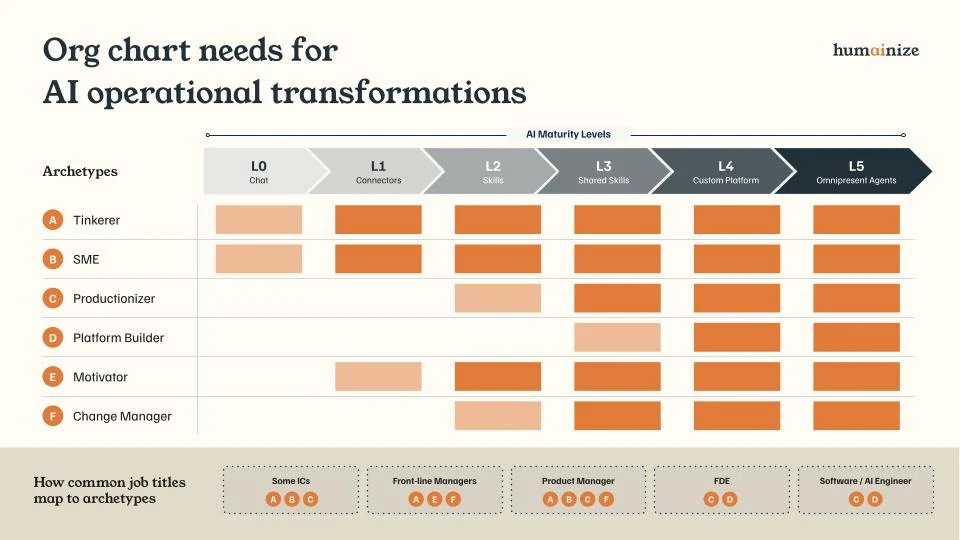
Six archetypes
These are archetypes of people - defined more by what kind of work they do with respect to building AI - rather than job titles, and one person often covers two or three of them at once.
| Archetype | What they do | Do you already have one? |
|---|---|---|
| Tinkerer | Experiments with new tools and automates their own work. Not necessarily an engineer. | Almost certainly, and you can probably name them. |
| SME | Knows the domain you're changing cold, exceptions included. Bookkeeping, dispatch, whatever it is. | Yes. |
| Productionizer | Takes a rough prototype and makes it reliable, repeatable, and plugged into the rest of your systems. An expert on AI rather than on your domain. | Usually not. |
| Platform Builder | Thinks about your company's shared AI plumbing: build versus buy, and which building blocks lots of teams could reuse. | Rarely, outside of tech. |
| Motivator | A leader, often somebody's direct manager, pushing their team to find efficiencies, ideally by example. | Yes, though not always pointed at this. |
| Change Manager | Trains people, gathers feedback, and carries the folks learning a new workflow while still doing their day jobs. | Sometimes, and rarely with time for it. |
One split worth noticing: the first three build the automation, and the last three build the system around it. An AI rollout needs both, and the second half is usually the more easily forgotten half.
Most of them are already on your payroll
If it feels like the early going is easy, that's because it is. The first few rungs of the adoption ladder run on people you already employ.
| Rung | Who needs to be hired |
|---|---|
| L0 → L1 | Nobody new. Find the Tinkerers who are also SMEs and get out of their way. They usually self-select. |
| L1 → L2 | Still nobody new hired. A few of those Tinkerers start doing Productionizer work on their own prototypes, and a Motivator starts to matter, because now there's something specific to point people toward. |
| L2 → L3 | A dedicated Productionizer, a first real dose of Platform Builder, and somebody actually owning change management. This is typically where "you already have these people" stops being true. |
| L3 → L4 | A Platform Builder proper, usually an engineer, working in a tight loop with the Productionizer. A PM or forward-deployed engineer often picks up the SME and change-management translation. |
| L4 → L5 | The same roster, running harder, plus a second kind of change management: between the platform people and the teams whose work keeps shifting underneath them. |
One note on the Motivator: they matter less than you'd think before L2. Earlier than that they're applying pressure with nowhere useful to aim it, and the team can usually see through that.
The rung where the org chart actually changes
Up to L2, sharing happens by copy-paste, or by somebody emailing a folder around. That works fine between two Tinkerers, and stops working almost immediately after.
A skill that does eighty percent of one person's month-end close does nothing for the other five people on that team until somebody hardens it, writes down when to use it and when not to, and teaches it. That's what the jump from L2 to L3 is about. That's coordination work, and coordination generally isn't what made your Tinkerer good at this in the first place. Asking them to do it on top of everything else tends to get you neither the coordination nor any more automations.
So L2 to L3 is where the org chart changes, and it changes in three places at once:
- Somebody to harden things. Turning a personal skill into something five people can run, including the part where it breaks and somebody has to notice.
- Somebody to stand up the shared library. Where skills live, who's allowed to change them, and what happens when two teams want slightly different versions of the same thing.
- Somebody to own adoption. You're now spreading a new way of working to people who didn't build it and didn't ask for it.
The first two you can hire for, or bring in a contractor or an outside partner for. The third is harder to buy, because it needs standing inside your company and a real read on the people involved.
What the first addition usually looks like
The question we get at this point is whether L3 means a headcount request. It doesn't have to, and here's the order we'd suggest thinking about it in.
- Start by reassigning, not hiring. The change-management half often works better as an explicit part of a front-line manager's job than as a new person. If a manager takes it on, take something else off their plate in writing, or it'll lose to their day job.
- You don't have to start with a full-time resource. This work is bursty at the start. A contractor or partner hardening the first two or three skills also establishes a pattern your own people can follow afterward, which is most of the value.
- Hire the Platform Builder last, and only against a real backlog. If you can't name four or five things a shared platform would unblock, it's early. The data and infrastructure roadmap in an AI strategy is where that backlog should be coming from.
When we look across companies, what tends to work is one person with real ownership and protected time, plus outside help on the technical half, rather than hiring up a new team. Companies that jump straight to hiring an AI lead before there's a backlog often end up with a capable person and nothing queued up for them.
Back to the skills that sat there
At that accountancy, that month-end automation that a tinkerer built didn't fail on the technology. The technology actually worked great!
It failed because nobody hardened it, nobody had anywhere to put it, and it wasn't anybody's job to get the other five people on that team using it.
Working out which of the six archetypes of talent you're missing for the rung you're on is something you can do this week, on your own, with a pen. If you'd like a helping hand, send us a note, we're happy to chat.