In an AI show-and-tell session I helped organize, a small business owner showed off a CRM he'd built himself on Replit. Not a prototype. The thing runs in production at his company, which has several dozen employees.
Someone asked how many other people there were building things like that. None.
That's the most common pattern we see: one person well ahead of the company on AI, and everyone else able to watch it happening without being able to do it themselves. Here's a way to figure out where your company sits today, and what it takes to move.
Placing your company
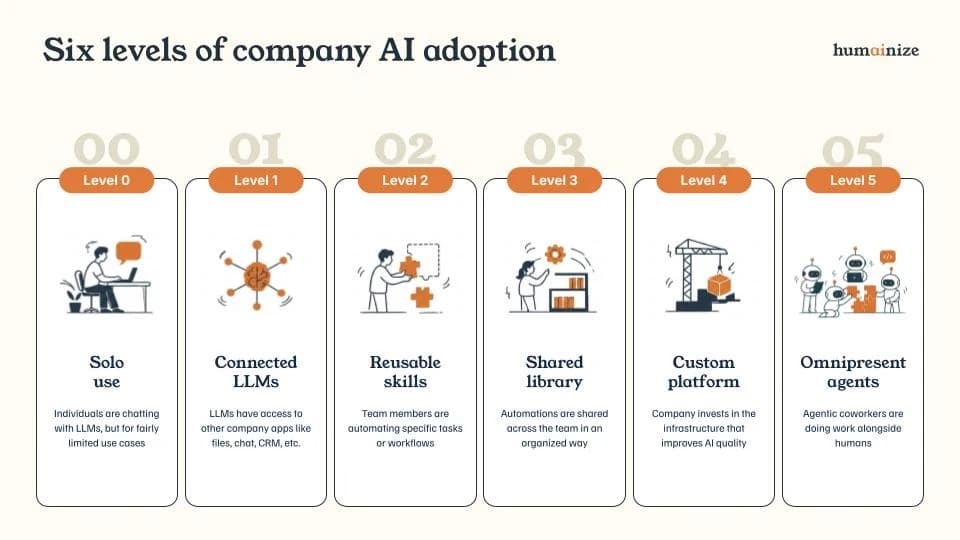
The scale below borrows its shape from the one the automotive industry uses for self-driving cars, which runs from level 0 (no automation) up to level 5 (the car drives itself anywhere). Waymo today sits at level 4: fully self-driving, but only inside an area that's been mapped in advance.
This framework about levels of AI adoption is built for companies that existed before any of this arrived, with real people and processes already in place. It's not a map toward running your business with a tenth of the staff.
| Level | What is happening | How you know you're here |
|---|---|---|
| L0 | Personal accounts, used alone. Drafting an email, tidying up a message, summarizing a thread. | People think of AI just as copy editing. You'd struggle to name who uses what. |
| L1 | The AI is connected to your real systems: email, files, calendar, the CRM. Read access first, then write. | Someone's stopped pasting things in and started asking the AI to go look. |
| L2 | One or two people build reusable "skills": saved instructions for a specific recurring piece of their job. | There's a person everyone points to when AI comes up. |
| L3 | Those skills spread. A teammate uses one they didn't build, and it holds up. | Someone who isn't technical relies on an automation daily. |
| L4 | Real budget goes into shared plumbing: knowledge layers built for AI retrieval, a managed skill library, sometimes custom tooling. | There's budget and/or headcount for it, and someone's job description mentions it. |
| L5 | Agents are a standing part of how work gets done, invokable by anyone. | You'd notice if they were switched off. |
A couple of notes on reading it.
The right-hand column matters more than the middle one. Companies routinely describe themselves a level higher than the "tell" supports, usually because a pilot exists somewhere. The question isn't what's been built, it's whether somebody depends on an automation day to day.
Each level has a mindset attached, and the mindset usually moves before the tooling does. At L0 the sense is that AI writes well but can't really automate anything. At L1 it's that context is the thing that unlocks more power. At L2 people stop thinking in tasks and start thinking in automations. By L4 the company has started describing itself as an AI company, whatever industry it's in.
Almost everyone is at level two
L2 is where the "tinkerers" surface. Every company has them, in every industry, and they're typically three to five percent of the workforce: the people who like new tools, like automating their own work, and like piecing things together. They might have been engineers in another life.
Give them AI connected to real systems and they start building. The month-end reconciliation. The weekly report nobody enjoys. The CRM that didn't exist. The work is usually good, and it usually takes real hours off their own week.
Then it stops there. The tinkerers keep tinkering and keep producing useful things, and neither what they build nor the way they think about it spreads across the company.
This generally isn't due to excess caution. None of the companies we've worked with stalled because of a mistake that scared everyone off, or because skills sprawled out of control. The more common reason for the stall is that there's simply no good playbook for this yet.
Why level three is hard
Three things get in the way, and only one of them is really about technology.
- Handing a skill to a non-tinkerer is a different job than handing it to another tinkerer. A tinkerer will read it, adjust it, and notice when it's misbehaving. Someone else has to trust it, know when it applies, and know when to stop using it. Most companies don't have a model for that handoff.
- The products are early here. Even the more thoughtful enterprise offerings are still building out the team-sharing pieces you'd want: a library people can search; version history; permissions; some visibility into what's being used and what isn't.
- Who owns the library of automations? IT? The function that adopted AI first? A committee? The tinkerer (by default)? Without an answer, nothing gets curated, nobody knows what exists, and it stops compounding.
Extending that last point: your tinkerer is usually an operator with a full day job already. Curating a shared library isn't in their week anywhere, and asking them to take it on alongside everything else is generally a great way to squash their enthusiasm. Who does this work, and at what level of seniority, is something we've written about separately in the AI transformation org chart.
What moves a company to level three
The companies we've seen cross the gap did a version of the following, and none of it requires new software.
- Pick one workflow, not a platform. Choose a single recurring job and get that one automation used by everybody who does it. A company with one automation in real shared use is at L3. A company with forty automations in a folder, all of them used by one person, isn't.
- Give the library an owner who has the bandwidth. One failure mode is naming an owner without freeing up any of their time for this AI enablement work. Even a couple of hours a week can change the outcome.
- Write down when not to use it. Non-tinkerers get stuck on trust rather than on mechanics, and the boundaries are what let somebody use a skill without understanding how it works. They're almost always missing.
- Have the tinkerer teach it, not hand it over. Sitting with someone through one real run-through beats documentation, and it surfaces the assumptions the tinkerer didn't know they'd made.
- Count users, not skills. It's tempting to measure success by the number of automations built, but that's more of a vanity metric. The more useful one is how many people used an automation they didn't build this week.
Most of the difficulty at this stage is organizational rather than technical, which is worth knowing before you go looking for a product to fix it.
Levels four and five, briefly
Fewer companies are facing these, so they're worth understanding without planning around yet.
L4 is where leadership commits real money to shared plumbing: data organized for how AI retrieves it (rather than every tool querying raw sources, which is often slow and expensive), a managed skill library, and some way to check whether the AI is doing a good job. The jump tends to mean setting up more architecture or a "platform" within the company. It doesn't have to mean hiring AI engineers, though it does mean getting hold of technical capacity somewhere. It's also possible to fulfill this level by assembling the right set of tools together, which is its own subject and one we've written about in the piece on Lego bricks and booklets.
L5 is agents as part of everyone's day-to-day. The most concrete public example is Shopify, whose CEO has written about an internal agent anyone in the company can invoke from Slack to do things like draft a code change. The open questions at this level are mostly about governance rather than capability: who's allowed to have an agent do what, and using which data.
Where to aim
Not every company should be pointed at L5. There's a lot of value in getting to a working L3 and staying there, and we'd rather see that than a company that's bought L4-shaped software and is using none of it.
If you want a quick placement, try this: find the thing someone at your company has already automated for themselves, and count how many other people use it. If the answer is nobody, you're at L2 along with almost everyone else, and the question worth your time isn't which AI tools to buy. It's which single workflow is worth the work of getting one automation to spread.
That's a question you can work through on your own. If you'd like a helping hand, send us a note, we're happy to chat.